Training & qualification · 2027

One language. One standard. Meat.

A part-time learning pathway for people who want to describe, compare and assess meat quality transparently and to a common international standard.

216program hours16 in-person days · 24 curriculum modules
The architecture

Knowledge becomes reliable judgement.

Every hour has a clear purpose in developing sensory judgement.

120 h

In-person hub training

16 in-person days across eight two-day blocks. 40 hours of foundations and 80 hours of guided practice: tasting, describing, discussing and calibrating.

64 h

Digital learning

Eight hours per training month with Sensory-ID™: content, reflection and assignments that deepen learning between in-person sessions.

32 h

Mandatory tasting

One independently completed Tastingkiosk session per training month, lasting four hours. Repetition and documentation make progress visible.

120 + 64 + 32 = 216 hScope of the core program. International modules are optional additions.
The rhythm · 2027

Eight months that change your perception.

A reliable rhythm of in-person training, digital learning and independent tasting. The core program pauses in August.

March 202722.–23.Introduction · shared language and foundations
April 202719.–20.Scales, references and calibration
May 202703.–04.Descriptors and comparative tastings
June 202707.–08.Cuts, sample handling and reproducibility
July 202705.–06.Aging, temperature and product assessment
August 2027BreakSummer break in the core program
September 202713.–14.Application, peer review and blind tastingprovisional
October 202704.–05.International calibration and exam preparationprovisional
November 202722.–23.Completion, practical and written examinationsprovisional

In-person sessions are always on Mondays and Tuesdays. September, October and November dates are provisional. The allocation of topics provides guidance within the 24-module curriculum.

THE COMMON THREAD24

Modules. One goal: judgements that stand up to international comparison.

From first impression to explanation

How good does it taste – and why?

✓Perceive and nameUse shared descriptors to capture tenderness, juiciness, flavour, aroma profile and texture.
✓Compare and calibrateUse blind samples, references and coded repeat samples to identify scale errors and anchoring effects.
✓Assess meat in contextInterpret marbling, cuts, aging, temperature and differences within a cut professionally.
✓Take responsibility for a resultDocument, explain and defend assessments in professional discussion, supported by Sensory-ID™.
The qualification

A title earned through performance.

The curriculum concludes with written and practical examinations and a sensory research assignment. What matters is whether quality can be assessed transparently and reproducibly.

✓Written technical exam90 minutes on foundations, methodology and application.
✓Sensory project paper8–10 pages using documented Sensory-ID™ data.
✓Practical assessmentVisual meat assessment, including marbling, and blind tasting using scales and descriptors.
✓Calibration and professional discussionDemonstrate reproducibility with coded repeat samples and explain your judgement.

Attendance and completion: At least 70% of in-person hours (84 of 120 hours) are required for admission to the examination. Each examination component is passed at 70% of the available points. Digital assignments and Tastingkiosk tastings must also be documented. Details are set out in the Terms of participation.

After passing the final examinationIMSPInternational Meat Sensory Professional

Graduates may use “IMSP” after their name. This is based on a shared international curriculum and comparable examination standards across all training hubs. The certificate documents successful participation in the program and passing the final examination.
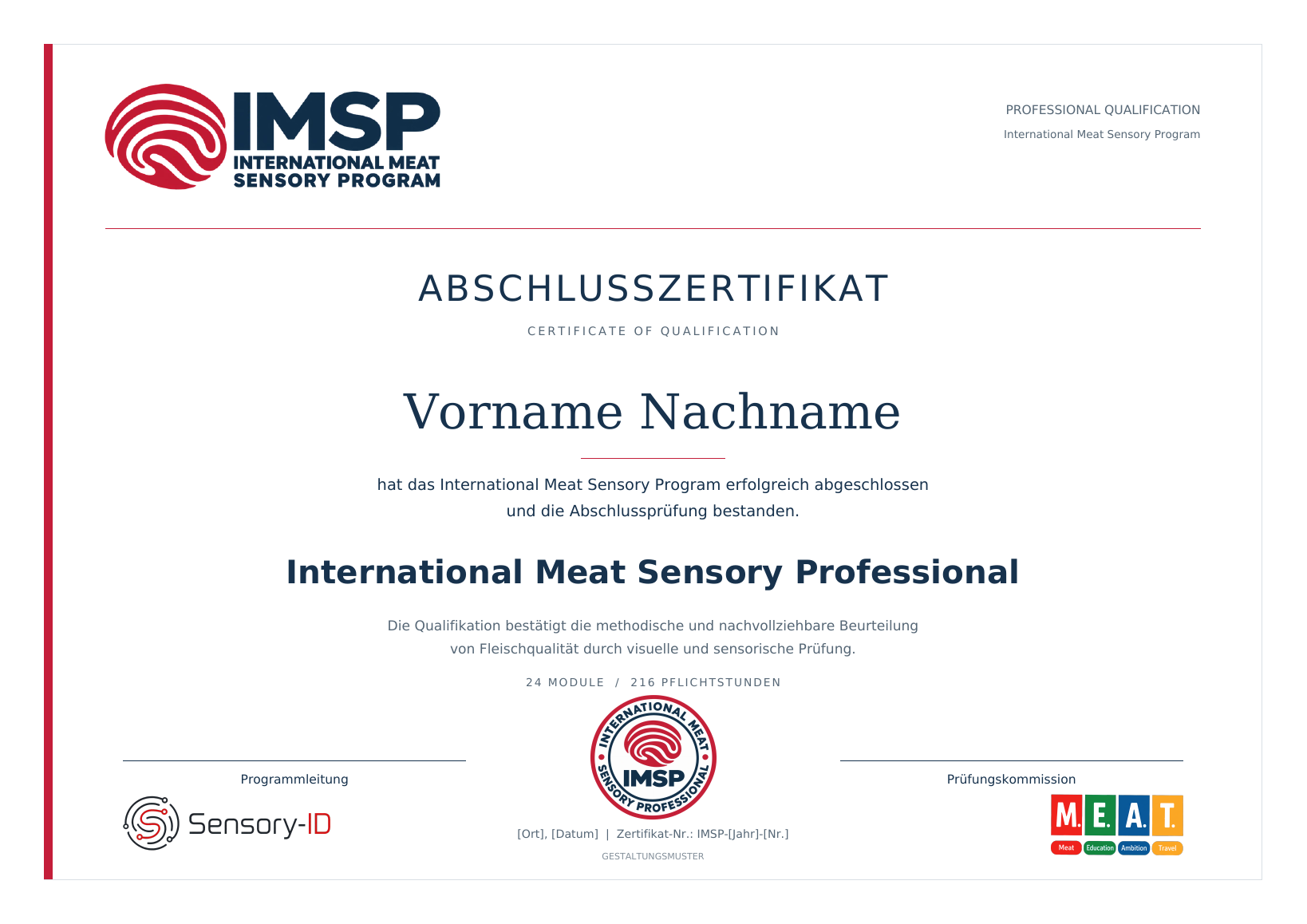
Sample IMSP completion certificate for the International Meat Sensory Professional, issued after successful program completion and passing the final examination
Your IMSP completion certificateDesign sample · Click to enlarge
Your participation

An investment in sound judgement.

Everything essential for the qualification is included in the core program.

CORE PROGRAM 20273.600 €net per person · business bookings (B2B)

Exclusively for businesses and entrepreneurs booking for business purposes, plus any VAT legally due. Optional specialist excursions are offered and charged separately.

✓216 hours in the core program120 in-person hours, 64 digital hours and 32 hours of independent Tastingkiosk tastings.
✓Full Sensory-ID™ accessThroughout the full actual course duration.
✓IMLN networkConnection to the international alumni and leadership network.
✓A consistent standardThe same core program and examination standard at every training hub.